
Custom LPC811 Controller for Alpha 4200C LED Message Display


_edited.jpg)


I designed and built a custom embedded controller board for an Alpha 4200C / 4200C120 tri-color LED message display, a commercial 16×200 LED message sign originally designed for RS-232/RS-485 control.
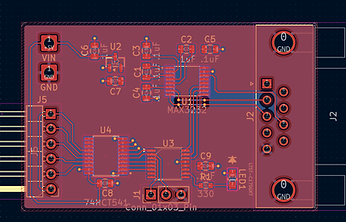
The goal of the project was to replace the original display control hardware with a compact custom board that could receive frame data from a Linux desktop and drive the LED matrix directly. I started by building and validating the circuit on a breadboard, then converted the design into a KiCad schematic and PCB layout, had the board fabricated, assembled it, and tested it on the final display.
The controller uses an LPC811 Arm Cortex-M0+ microcontroller running firmware written in C. The LPC811 refreshes the LED display at 100 Hz, providing smooth and stable output. A Linux desktop application, also written in C, sends display data over a serial connection.
Incoming serial data from the Linux PC is converted from RS-232 to logic-level UART using a MAX3232. The LPC811 processes that data and outputs the display control signals. Since the LPC811 operates at 3.3 V and the LED display expects 5 V logic, the output signals pass through an SN74HCT541 line driver to shift the signal levels up to the voltage required by the display hardware.
The board is powered directly from the display assembly. A 5 V rail powers the SN74HCT541, while an MCP1700T regulator generates the 3.3 V rail used by the LPC811 and MAX3232. I also added a small programming/reset header so the LPC811 firmware can be updated directly through the serial interface.
This project combined embedded C programming, Linux C development, serial communication, voltage-level translation, display timing, PCB design, hardware bring-up, and prototype-to-production workflow.
